Private Equity Value Creation: A Step-by-Step Guide to Maximizing Investment Returns

When you're weighing private equity investments, it's not whether or not a deal will work; it's how much value you truly can create. Private equity value creation is the difference-maker that separates best-in-class returns from average returns, and an understanding of these approaches makes or breaks your investment return.
You've probably seen that the days of effortless profits through financial engineering are mostly behind us. The private equity landscape now demands a far more intelligent means of generating returns. The firms that consistently beat the market aren't just buying companies and wishing upon a star—they're methodically transforming companies through proven value creation methodologies.
Dubai is emerging as a key global hub for private equity and alternative investments. According to the DIFC's report, investors are increasingly allocating to private equity in Dubai due to its growth potential and role as a financial center in the Middle East, offering opportunities for diversification and long‑term value.
No matter whether you're an investor weighing PE possibilities, an owner thinking about a private equity partnership, or a professional in the industry, this guide will supply the comprehensive insights you need. We'll break down exactly how value is created with private equity, what drives profitable transformations, and how you can apply these techniques to achieve the highest returns.
At Fiducia Adamantina, we have seen with our own eyes how the right approach to value creation can turn struggling companies into industry champions. Let's look at the highly specific strategies and tactics that enable such a transformation.
Knowing the Fundamentals of Private Equity Value Creation
What is Private Equity Value Creation?
Private equity value creation refers to the process through which private equity firms increase the worth of their portfolio companies. This can involve improving operations, expanding into new markets, or optimizing financial structures. Unlike traditional investments, private equity value creation is hands-on, requiring firms to actively work with portfolio companies to enhance their performance. It’s a comprehensive approach that combines operational excellence, strategic growth, and financial engineering to generate sustainable, long-term value.
Why is Private Equity Value Creation Important?
Private Equity Value creation is critical, as it directly affects the financial returns that private equity investors receive on their investments. By enhancing a company's financial performance, private equity firms create value that ultimately yields higher returns when the company goes public or is acquired. It helps realize the company's hidden potential and is thus an important determinant of success in the competitive world of private equity.
What Actually Drives Private Equity Returns
PE value creation operates through three primary levers, and familiarizing yourself with all of them is critical to your success. Operating improvements—running the business better, faster, and cheaper—first. Second is growth acceleration—increasing revenues by new markets, products, or acquisitions. Optimizing finance—optimizing capital structure and preparing for exit—third.
This is what you need to know: these levers do not act in isolation. The most successful private equity investments combine all three approaches under one cohesive strategy that addresses the distinctive challenges and opportunities in each business.
The Process of Private Equity Value Creation
The Evolution of Value Creation Strategies
The private equity industry has changed in the past decade. You could no longer generate profits mainly by leveraging. Instead, profitable firms focus on operational value creation, which is likely to create 60-80% returns in the current era.
This transformation necessitates being an operator, not an investor. You need to have firms where you can implement tangible changes in operations, strategy, and position in the market. Financial engineering is secondary—you must build a better business first.
Operational Excellence: The Foundation of Value Creation
Diagnostic Assessment and Baseline Establishment
To do something better, first you have to know precisely where the business stands today. That takes performing detailed operational diagnostics far beyond simple financial analysis.
Your diagnosis ought to look at all the critical functions of the business: sales and marketing capacity, operational performance, supply chain excellence, technology platform, human capital talent, and financial controls. You're looking for discrepancies between current performance and best-in-class standards. Studies have shown that operational improvements continue to be the prime source of value creation in private equity, with the majority of companies using systematic diagnostic tools to identify quick wins and long-term potential.
The best private equity managers use systematic diagnostic systems that avoid anything being missed. These include screening on key performance indicators, having a management interview, benchmarking against industry norms, and identifying quick wins and longer-term transformation opportunities.
Process Optimization and Standardization
After areas have been determined for improvement, process optimization will be the instrument of value creation. This will include optimizing best practices in areas such as business, eliminating redundancies, and developing systems that can enable optimal performance.
Manufacturing companies usually witness spectacular growth via lean manufacturing methods, waste reduction, and quality initiative programs. Service companies enjoy formal service delivery processes, customer relationship management systems, and performance measurement frameworks.
You wish to create scalable processes capable of accommodating business growth without like increases in complexity and expense. You're creating operating leverage that maximizes margin with revenue growth.
Technology Infrastructure and Digital Transformation
Value creation in the modern era requires serious attention to technology capabilities. You're not simply replacing antiquated systems—you're implementing integrated technology platforms that enhance decision-making, customer service, and operational efficiency.
Enterprise resource planning (ERP) applications form the bedrock of operating improvement initiatives. These systems bring together financial management, inventory management, customer relationship management, and operational reporting into integrated systems, providing real-time visibility into business performance.
Customer Relationship Management (CRM) software is also a must, more so when businesses involve multi-step selling or have repeating business relationships. They are key in improving sales productivity, using the software for customer services, as well as providing significant data needed in strategic decision-making.
Analytics capability has become essential in terms of identifying opportunities for improvement in various areas and in monitoring results. It entails getting business intelligence systems up and running, establishing key performance indicators, and creating reporting systems that enable active management.
Supply Chain Optimization Strategies
Supply chain improvements generally generate some of the fastest and longest-lasting value creation opportunities. You're looking at every aspect of how materials are being bought by the company, managed through inventory, and delivered to customers in terms of products or services.
Procurement optimization involves looking at supplier relationships, renegotiating better terms, consolidating suppliers where possible, and implementing strategic sourcing procedures. This generally provides short-term cost reduction while improving supplier relationships and service levels.
Improvements in inventory management can free up significant working capital and reduce the risk of stockouts and obsolescence expense. This may involve implementing demand planning systems, reducing safety stocks, and increasing inventory turns.
The objective of improvement of logistics and distribution lies in decreasing the cost of transport, optimizing delivery time, and achieving maximum customer satisfaction. It could involve optimizing the logistics network, transport management systems, or renegotiating transport contracts.
Organizational Development and Talent Management
Human beings drive business performance, and successful value creation relies significantly on sensitivity to human capital development. This goes far beyond bare minimum hiring and compensation and incorporates a full-scale talent management strategy.
Leaders are required to complete programs that improve the management team's capabilities to deliver value-creation strategies. This involves identifying talented employees and planning for their succession in critical areas.
Performance management systems link individual performance to organizational goals. It means defining effective performance goals, developing review procedures, and organizing compensation packages to promote value creation.
Cultural change can become necessary when the introduction of significant operational changes are implemented. This entails open communication of new expectations, regular reinforcement of desired behaviors, and culture change-supporting systems throughout the firm.
Financial Engineering and Capital Optimization
Capital Structure Optimization
While operating efficiency creates the lion's share of the value, capital structure optimization remains an important component of total returns. This entails finding an optimal balance between debt and equity capital that provides the highest returns while maintaining financial flexibility.
Optimization leverage demands thoughtful examination of the stability of cash flows, growth capital needs, and market conditions. You want to find the best level of debt that maximizes returns without inducing unacceptable financial risk.
Refinancing opportunities using debt can minimize interest expense and maximize financial flexibility. This entails tracking market conditions, staying in touch with multiple lenders, and organizing refinancing operations to take advantage of good market conditions.
Working Capital Management
Working capital optimization can significantly improve cash and returns by reducing the amount of capital tied up in operations. It is done through optimization of accounts receivable, inventory, and accounts payable to maximize cash conversion cycles.
Accounts receivable management focuses on speeding up collections while maintaining customer relationships. This involves enforcing credit policies, improving collection procedures, and possibly factoring or other financial devices to accelerate cash flow.
Inventory optimization is a balancing act of the need to offer service levels versus the need to reduce working capital requirements. That involves improving forecasted demand, safety stocks optimization, and using just-in-time inventory practices where feasible.
Accounts payable optimization involves negotiating better payment terms with vendors with whom you have good relationships. That can involve early payment discounts, extended terms of payment, or vendor finance schemes.
Private Equity Investment Strategies
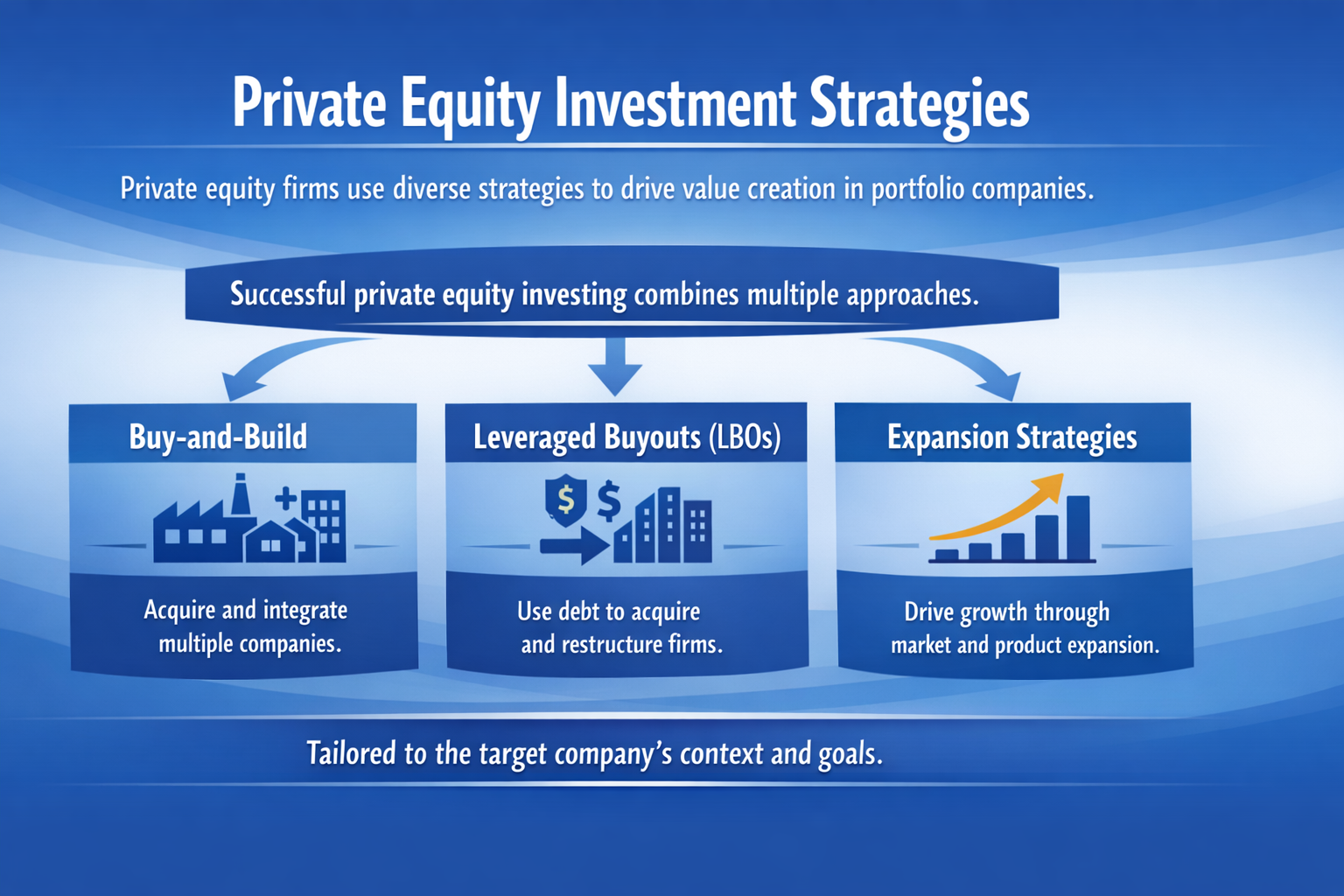
Private equity firms employ diverse strategies to drive value creation in portfolio companies. The strategy seeks to maximize value by aligning the growth strategy, financial restructuring, and the process approach. It should be noted that a successful formula in private equity investing combines several approaches, including the Buy-and-Build, Leveraged Buyouts (LBOs), and Expansion strategies. The strategy is tailored to the target private equity company or the context surrounding it.
Buy-and-Build Strategies for Diversified Expansion
Platform Company Choice and Development
The buy-and-build strategy starts with finding the right platform company that can serve as the foundation upon which to make several acquisitions. Your platform should have strong management capability, scalable operations, and financial wherewithal to enable acquisition integration.
Evaluating management teams is key to success in buy-and-build. You need leaders who will execute organic growth strategies and acquisition integration, as well as operational performance, as you grow.
Scalability analysis is the understanding of what components of the business are able to handle significantly greater size without offsetting increases in cost or complexity. These are systems, processes, organizational design, and operating capacity.
Acquisition Target Identification and Evaluation
Market scanning methodically identifies acquisition targets that offer strategic value in geographic expansion, product complementarity, or operating synergies. It involves developing detailed acquisition criteria and active lists of potential targets.
Strategic fit analysis goes beyond financial measures to evaluate the extent to which prospective acquisitions will mesh with continuing operations and contribute to overall value creation objectives. You're looking for businesses that build a competitive position with clear synergy potential.
Add-on acquisition due diligence procedures must be streamlined without sacrificing thorough examination of major risks and opportunities. Financial, operational, legal, and cultural due diligence must be accomplished in order to make sound acquisition decisions.
Integration Excellence and Synergy Capture
Integration planning should start in the due diligence phase to ensure smooth transitions and rapid synergy capture. This involves establishing complete integration timetables, having priority risks defined, and setting success criteria.
Cultural integration typically succeeds or fails in acquisition plans. It encompasses an understanding of the cultures of the two organizations, identifying conflict zones, and creating ways that do not sacrifice the best of both cultures but become one in purpose.
Systems integration provides synergies of operation and increased management visibility. This can take the form of harmonization of ERP systems, financial reporting integration, or a shared services center for back-office operations.
Synergy execution requires disciplined execution and diligent tracking of benefits. These include both cost synergies through operating efficiencies and revenue synergies through expanded market coverage or enhanced capabilities.
Leveraged Buyouts (LBOs) in Private Equity
A leveraged buyout (LBO) is a common strategy used in private equity to acquire a company using a combination of debt and equity. In this structure, the private equity firm borrows a significant portion of the purchase price, using the assets of the target company as collateral. This allows the firm to control a larger company with less upfront capital. After the acquisition, the focus shifts to improving operations and increasing profitability, which ultimately allows the firm to pay down the debt while creating substantial value through operational improvements and strategic growth.
Revenue Growth and Market Expansion
Revenue growth and market expansion are essential strategies for driving value creation in private equity. By identifying new revenue streams and expanding into untapped markets, private equity firms can significantly increase the value of a portfolio company. This can be achieved by launching new products, entering new geographic regions, or targeting different customer segments. The goal is to ensure that the company is well-positioned for long-term, sustainable growth, ultimately improving its financial performance and valuation.
Market Analysis and Opportunity Identification
Effective revenue expansion starts with assertive market research that identifies the optimal opportunities for expansion. You need to be aware of market size, growth, competitive dynamics, and customer needs to make informed expansion decisions.
Competitive research reveals market gaps and positioning opportunities that drive revenue expansion. Firms with a strategic acquisition strategy and leveraging market intelligence have been shown to outperform competitors in the acquisition of new market share.
Geographic Expansion Strategies
Geographic expansion holds tremendous revenue growth opportunities if executed correctly. However, successful expansion requires careful examination of regional market dynamics, regulatory requirements, and competition.
Expansion within the domestic market typically presents the fastest route to revenue growth by leveraging established strengths and customer bases. This may involve creating new locations, expanding sales territories, or developing regional distribution partnerships.
Foreign expansion requires more planning and implementation ability. You will need to understand local laws, cultural preferences, competitive conditions, and operating requirements. Success will often hinge on partnerships with native groups that provide market knowledge and operating support.
Product and Service Diversification
Product line extension can drive significant revenue growth by leveraging existing customer relationships and operations. The key is identifying products or services that are complementary to existing offerings but reflect genuine customer demand.
Opportunities emerging in nearby markets often have significant diversification potential with acceptable risk levels. This involves leveraging core competencies to address related customer needs or nearby market segments with comparable characteristics to existing markets.
Development and innovation programs can create new lines of revenue entirely through proprietary products or services. For this, investment in research and development competence, market research, and new product introduction processes is required.
Customer Acquisition and Retention
Internet marketing has transformed customer acquisition programs in almost all industries. These include search engine optimization, social media marketing, content marketing, and targeted advertising campaigns directed at select customer segments.
Streamlining the sales process improves conversion rates and reduces customer acquisition costs. This involves scrutiny of the entire customer experience, identifying bottlenecks or areas of friction, and improving to serve customers better.
Customer retention strategies focus on optimizing the lifetime value of existing customers. These include loyalty programs, customer service improvement, upselling and cross-selling, and proactive account management of key customers.
Strategic Partnerships and Alliances
Partnership strategies can fuel revenue expansion by providing exposure to new channels of sales, complementary capabilities, or enhanced market reach. The difficulty is identifying partners whose complementary strengths match yours in pursuing common objectives.
Distribution partnerships provide entry to established sales channels without the cost and time involved in building direct selling capabilities. This works best for geographic expansion or expansion into new customer bases.
Technology alliances can extend product or operating capabilities via integration with complementary technologies. This enables differentiated value propositions with premium price capability.
Commercial Excellence
Commercial excellence is about optimizing the company’s sales, marketing, and operational processes to increase revenue and improve profitability. This involves refining the go-to-market strategy, enhancing customer acquisition tactics, and streamlining sales cycles. For private equity firms, achieving commercial excellence in their portfolio companies ensures that every revenue opportunity is maximized, driving both top-line growth and bottom-line profitability.
The Growing Importance of Operational and Strategic Value Creation
As private equity firms shift away from purely financial engineering, operational and strategic value creation has become more important than ever. Successful firms focus on enhancing operational efficiency, improving processes, and implementing growth strategies that create long-term, sustainable value. This approach requires a hands-on approach, where the firm’s expertise is actively used to transform a portfolio company’s operations, culture, and market position.
Capital Efficiency and Deleverage
Capital efficiency is about ensuring that the company is using its financial resources in the most effective way possible to generate returns. This involves optimizing the capital structure, reducing unnecessary debt, and making strategic investments that deliver the highest return. Deleverage refers to the process of reducing debt to improve financial flexibility, reduce risk, and enhance the company’s value. By focusing on capital efficiency and deleveraging, private equity firms can increase the portfolio company’s financial stability and profitability.
Value Creation and Exit Readiness
Creating a Winning Exit Strategy
Creating a winning exit strategy is essential for private equity firms looking to maximize returns. A well-planned exit allows firms to sell portfolio companies at the peak of their value. This includes positioning the company for an attractive sale or IPO, ensuring that all operational, financial, and strategic goals are aligned for the best possible outcome.
Exit Strategy and Multiple Enhancement
Exit planning needs to start early in the investment cycle to maximize value realization. This requires knowledge of the points of view of potential acquirers and positioning the business for the best valuation multiples at exit.
Identification of strategic buyers requires consideration of likely acquirers who could attach strategic value to the business because of synergies, market consolidation potential, or complementary skills. Knowledge of buyer motives facilitates better positioning tactics.
Financial buyer positioning is the process of creating businesses that are attractive to other financial investors or private equity firms. It involves demonstrating sustainable cash flow growth, a scalable business, and a repetitive value creation opportunity.
Challenges in Private Equity Value Creation
Market Volatility
Market volatility can significantly impact the value creation process in private equity. Fluctuations in the economy, stock market, and interest rates can create uncertainties that affect the valuation of portfolio companies. Private equity firms need to be prepared to manage these risks and adjust their strategies accordingly to navigate through market challenges.
Regulatory Changes
Regulatory changes can have a profound impact on private equity investments. Changes in tax laws, financial reporting requirements, or industry-specific regulations can affect a portfolio company’s operations and profitability. Staying ahead of regulatory changes is crucial for private equity firms to ensure that their value creation strategies remain compliant and effective.
Operational Hurdles
Operational hurdles such as talent shortages, inefficient processes, or outdated technology can slow down value creation. Private equity firms need to be proactive in addressing these issues by optimizing operations, implementing new technologies, and developing strong management teams. Overcoming these operational challenges is key to driving long-term value and achieving success in private equity investments.
Measuring and Monitoring Value Creation
Key Performance Indicators and Metrics
Effective value creation requires comprehensive measurement systems that track performance for all value creation activities. This includes establishing starting point metrics, setting improvement objectives, and maintaining ongoing reporting arrangements.
Financial measures form the foundation for measuring value creation. This includes rates of revenue growth, margin improvement, cash flow generation, and return on capital invested. These should be tracked on a monthly basis with complete variance analysis.
Operational measures provide early indicators of value creation traction. This may include customer satisfaction measurements, employee engagement scores, measures of operating efficiencies, and quality metrics that drive financial outcomes.
Reporting and Dashboard Systems
Executive dashboards allow for real-time tracking of value creation progress for every portfolio business. These systems should highlight key performance measures, identify trends, and alert management to issues that require their attention.
Regular reporting cycles ensure systematic monitoring and forward-looking management of value creation initiatives. This typically includes monthly business operating reports, quarterly comprehensive reviews, and annual strategic checks.
Benchmarking analysis helps to reveal additional improvement potential by comparing performance with industry benchmarks, best-in-class practices, and peer firms. This enables continuous value creation potential identification.
Enhance Private Equity Investments with Fiducia Adamantina
Private equity value creation boosts profitability and ensures premium returns. At Fiducia Adamantina, we combine expert insights and strategic tools to drive operational and financial growth for portfolio companies. Our approach helps private equity firms implement value creation strategies effectively while optimizing operations for successful exits.
Contact Fiducia Adamantina for expert guidance on unlocking the full potential of your investments.
Conclusion: Building Sustainable Private Equity Value
Successful private equity value creation is an integrated approach that prioritizes operational excellence, revenue expansion, and financial optimization through disciplined, systematic action. Better returns result from the companies that extend value creation as a sustained process, rather than an episodic phenomenon.
Your ability to achieve success in generating value in private equity rests on an understanding that each investment is unique, with requirements individually designed to meet specific market conditions, competition scenarios, and business profiles. The models and approaches described within this guide form a foundation for developing these customized solutions.
The key takeaway in using private equity value creation methods is that success requires strategic planning as well as operating execution. You need to identify the right opportunities, design end-to-end improvement programs, and execute them with disciplined project management and continuous monitoring.
Forward, the private equity industry will continue to grow, but operational excellence, strategic positioning, and active management will remain the keystone of successful value creation. Those companies that excel in those concepts while adapting to respond to changing market conditions will be the top performers for their investors and portfolio companies.
Fiducia Adamantina combines these proven PE value creation techniques with local market knowledge and global best practices to create long-term outcomes. Whether evaluating investment opportunities or optimizing value creation from current portfolios, these techniques are the key to creating better returns in today's challenging, competitive private equity landscape.
Related articles:
- The M&A Process explained
- M&A Due Diligence Checklist
- M&A Negotiation Tactics
- Top Questions to Ask During Merger & Acquisition
- When Is The Right Time To Sell Your Business


Zubail Talibov specializes in crafting and executing transformative strategies that drive business growth. Her expertise encompasses market intelligence, competitive analysis, and strategic decision-making. She is well-versed in navigating complex business environments and guiding organizations toward sustainable success.
Book Your Consultation
Related Services
.avif)
Find a financial advisor in Dubai. We help shortlist licensed advisors and support wealth planning, cash flow, protection, and estate basics.


Looking for trusted wealth management consultancy in Dubai? We offer expert wealth management, asset protection, and legacy planning for lasting success.

Fiducia Adamantina’s Marketing Consulting Delivers Data-Driven Strategies for Maximum Impact